
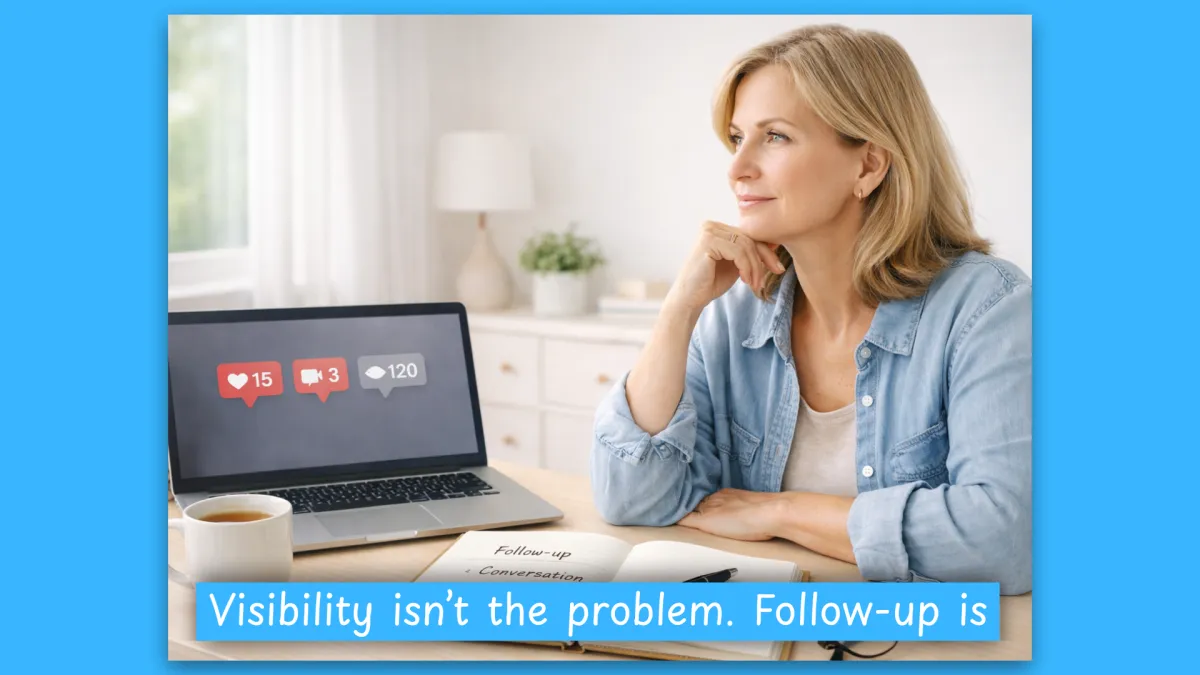
Visibility Isn’t Your Problem — Follow-Up Is
Early on, I tracked what most people track.
Likes.
Comments.
Views.
Engagement.
I was posting consistently and showing up every week. From the outside, it looked like progress. I was doing what every visibility strategy says to do.
But something didn’t feel quite right.
People were seeing the posts.
Yet very few conversations were happening.
There weren’t many inquiries.
There weren’t many discovery calls.
There weren’t many leads.
For a while, I assumed the problem was the content.
Maybe I needed better hooks.
Maybe I needed stronger messaging.
Maybe I needed to post more often.
But eventually I realized something simpler.
Visibility and conversion are not the same thing.
Posting introduces people to your work, but it doesn’t move the relationship forward on its own.
What began to change things for me was shifting my attention away from engagement metrics and toward actual conversations with interested people.
Lead generation.
Follow-up.
Continuing the conversation after the first interaction.
The visibility was already happening.
What was missing was the structure that continues the relationship after someone first shows interest.
Over time, that became clear.
Revenue rarely appears in the first touch.
More often, it appears in the second, third, or fourth conversation.
Visibility introduces you.
Follow-up builds the business.
When Visibility Gets Too Much Credit
Many business owners assume inconsistent revenue is mainly a visibility problem.
So the instinct is to increase activity.
More posting.
More platforms.
More consistency.
But attention and traction are not the same thing.
Visibility introduces your work to people who may be a fit. It opens the door to awareness.
Conversion happens later, inside the relationship that follows.
If that relationship never continues, your business starts over every day.
Each post must create new attention because the people who already showed interest were never nurtured.
That creates unnecessary pressure on visibility.
What Actually Happens When Follow-Up Is Weak
When follow-up systems are missing, interest fades quietly.
Someone downloads a resource but never hears from you again.
Someone attends a webinar, and the conversation ends there.
Someone expresses interest, and then life gets busy.
Nothing dramatic happens.
The relationship simply stops before it has enough structure to continue.
From the outside, this often looks like a marketing problem.
But the underlying issue is continuity.
The business introduced itself.
It just didn’t support the next step.
Why This Feels Especially Heavy For Midlife Business Owners
At this stage of life, capacity matters more.
Energy is not theoretical.
Health is not separate from work.
Real life does not pause for a content schedule.
That changes how business strategies feel.
A visibility-heavy strategy requires constant decisions.
What should I post next?
Where should I show up?
What message should I share?
Over time, that creates decision fatigue.
This is one reason capacity-based business planning becomes important.
Instead of asking only what might grow the business, it asks what kind of growth the business can actually support without creating unnecessary strain.
Sometimes the answer is not more visibility.
Sometimes the answer is better continuity.
Midlife Buyers Often Move Through Relationship Cycles
Many women serving midlife clients notice something similar.
Their buyers rarely make instant decisions.
They reflect.
They revisit.
They return to the conversation later.
That pattern is not hesitation.
It is thoughtful decision-making.
When the business expects the first interaction to carry the entire sales process, these buyers are easily misread.
Interest existed.
The structure to continue the relationship did not.
Follow-up systems make room for this natural pace.
They keep the conversation open without adding pressure.
Systems Reduce Decisions
A business becomes difficult when too much depends on memory.
If follow-up lives only in your head, it becomes one more thing to track.
Did I respond?
Has it been too long?
Should I reach back out?
Those small decisions accumulate.
A system removes that weight.
It provides a natural next step after someone opts in, attends something, or expresses interest.
The business continues the relationship without requiring constant mental effort.
That connection between systems and steadier revenue is often overlooked.
Revenue rarely disappears because people have never shown interest.
More often, it disappears because someone did not continue the conversation.
Visibility Creates Awareness. Follow-Up Creates Continuity.
Here is the pattern that appears repeatedly in service businesses.
Visibility creates awareness.
Follow-up creates continuity.
Without continuity, visibility has to work much harder than it should.
A short way to understand this:
Visibility introduces you.
Follow-up builds the relationship that leads to revenue.
When that relationship structure exists, growth becomes quieter and steadier.
The business stops depending entirely on constant attention.
Is the Real Issue Lead Volume or Lead Continuity?
When revenue feels uneven, many founders assume they need more leads.
Sometimes that is true.
But often the business already has people who have:
Downloaded something
Attended something
Replied to something
Expressed interest
The better question becomes:
What happened next?
That single question often reveals where revenue quietly fades.
This is also why planning matters.
If you read the earlier piece Why Selling Feels Heavy When Your Offer Isn’t Clear (And How to Make It Lighter, the same principle applies here. Planning reduces unnecessary decisions and builds a supportive structure around the parts of the business that matter most.
Follow-up is one of those structures.
Seeing the Pattern More Clearly
Many thoughtful entrepreneurs hesitate to follow up because they associate it with pressure.
But thoughtful follow-up is not about persuasion.
It is about continuity.
It gives interested people a place to continue the conversation when the timing is right.
When that structure exists, the business begins to feel different.
Visibility still matters.
But it no longer carries the entire weight of conversion.
I walk through this pattern more fully in this week’s YouTube video:
👉 https://youtu.be/x3BqGjOdfUg
Sometimes hearing the framework explained out loud makes the pattern easier to recognize inside your own business.
A Calm Next Step
If your visibility efforts feel more difficult than they should, the useful question may not be about content.
It may be about follow-up.
Not how many people saw your work.
What happened after someone showed interest.
I also created a support prompt for this week that helps you look at your follow-up structure more clearly. It acts as a thinking partner so you can see where conversations may be ending earlier than they need to.
You can access that prompt in this week’s video on YouTube.
👉 https://youtu.be/x3BqGjOdfUg
And if you want to continue receiving these reflections and the weekly AI prompts that accompany them, you can subscribe to the blog.
They are written for women building businesses inside real lives, where energy, health, and capacity are part of the strategy.
Because sometimes the next step is not more visibility.
It is simply giving the relationship a place to continue.


